Every hosting business hits the same fork in the road eventually: keep sending clients elsewhere to buy domains, or start selling domains yourself. I’ve watched hosts leave real money on the table for years because they assumed domain reselling meant becoming a full-blown registrar with ICANN accreditation and a compliance team. It doesn’t — not if you’re already running WHMCS.
Yes — WHMCS lets you resell domains natively through its built-in registrar modules, but out of the box that’s a single-tier setup with no sub-reseller accounts, tiered pricing, or reseller dashboard. For a real multi-tier reseller business, you need a dedicated tool like Domain Reseller for WHMCS.
What “reselling domains” actually means
Reselling domains isn’t the same thing as becoming a registrar. You’re not applying for ICANN accreditation, you’re not signing a registry agreement, and you’re not on the hook for compliance audits. You’re plugging into a registrar’s API through WHMCS, marking up the wholesale price, and letting your own clients register, transfer, and renew domains without ever knowing there’s a wholesaler behind the curtain. That’s it. If you already run a hosting business on WHMCS, you’re closer to doing this than you think.
The confusion usually comes from the word “reseller” doing double duty. WHMCS itself can register a domain for a client the moment they check out — that’s domain automation, and it’s been part of the core product forever. Domain reselling as a business model is a different layer on top: sub-accounts, tiered pricing, a dashboard your resellers log into, and reporting on who’s making you money. WHMCS wasn’t built with that second layer in mind, and it shows the first time you try to set it up.
What WHMCS gives you natively
Out of the box, WHMCS ships with built-in registrar modules for a long list of major domain wholesalers — you pick one, drop in your API credentials, and WHMCS handles registration, renewal, and transfer requests against that registrar’s inventory. You can set retail pricing per TLD, turn on domain sync to pull expiry and status changes automatically, and let clients manage nameservers and contact details from their client area. For a host who just wants “.com and a handful of ccTLDs” available at checkout next to a hosting plan, this native setup is genuinely fine. It’s not broken. It’s just built for one thing: a single business selling domains to its own clients.
Where the native setup runs out of road
The cracks show up the moment you want anything more layered than that. A few things I hear constantly from hosts who’ve outgrown the native domain module:
- No sub-reseller accounts. There’s no built-in concept of “give this partner their own login, their own credit balance, and their own markup” — every domain sale runs through your single WHMCS instance with one pricing table.
- No per-group TLD pricing. You can’t easily charge Group A one rate and Group B a different rate for the same TLD without manual overrides scattered across products.
- No reseller-facing dashboard. Your sub-resellers can’t log in and see their own order history, credit balance, or API usage — they’d need access to your admin area, which nobody wants to hand out.
- No income reporting by reseller. You can pull domain revenue totals, but not “how much did Reseller X generate me this quarter” without exporting and doing it by hand.
None of that means WHMCS is missing something — it’s just not a domain-reseller platform, it’s a client billing platform that happens to talk to registrars. Those are different jobs.
What a dedicated reseller module adds
This is the gap a purpose-built tool like Domain Reseller for WHMCS is built to close, and it’s worth walking through what actually changes once it’s installed.
A real reseller dashboard and API keys
Instead of every domain sale running through your admin login, each sub-reseller gets their own dashboard — order history, domain inventory, account credits, all visible to them without touching your backend. They also get their own API keys, with IP restrictions you control, so they can build against your inventory the same way you build against your upstream registrar. The module covers 15+ API operations: registration, transfers, renewals, DNS management, nameserver configuration, EPP code retrieval, availability checks, and more.
Pricing that actually reflects your business
TLD pricing can be set per reseller group, per currency, and per action (register, renew, transfer) — with support for custom pricing slabs, WHMCS’s own defaults, or promotional rates layered on top. That’s the difference between “everyone pays the same list price” and running an actual channel program where your biggest resellers get better margins.
Reporting that answers “who’s making me money”
The admin side gets TLD and reseller income statistics plus full API request/response logs — so when a reseller’s integration breaks at 11pm, you’re not guessing what happened, you’re reading the log. Admins can also assign clients to reseller groups with granular controls, set default registrant and contact details across the board, and even generate custom domain registrar modules for individual resellers to plug into their own systems.
Let shoppers check availability before they commit
If part of your funnel is a public-facing “search for a domain” box, pair the reseller setup with the WHMCS WHOIS module — it does instant availability checks and full WHOIS lookups (registrar, contacts, nameservers, registration dates) right on your storefront, no account required. It’s a small addition, but it removes friction right at the point someone’s deciding whether to buy from you.
Native vs. dedicated: side by side
| Capability | WHMCS native registrar module | Domain Reseller for WHMCS |
|---|---|---|
| Register/renew/transfer domains | Yes | Yes |
| Sub-reseller accounts & logins | No | Yes, with dedicated dashboard |
| Per-group / per-currency TLD pricing | Limited | Yes, with custom pricing slabs |
| Reseller API keys with IP restrictions | No | Yes |
| TLD & reseller income statistics | No | Yes |
| Full API request/response logs | Limited | Yes |
| Automatic reseller creation from purchases | No | Yes |
Neither column is “wrong” — if you’re not planning to run sub-resellers, the native module is one less thing to license and maintain. The moment a real reseller channel is part of your roadmap, though, the right column stops being optional.
A quick gut-check before you commit
Ask yourself three things. Do you have (or want) partners who’d sell domains under their own brand through you? Do you need different TLD pricing for different groups of resellers, not just different clients? And do you need to answer “which reseller is actually profitable” without opening a spreadsheet? If you answered yes to any of those, the native setup was never going to get you there — that’s not a knock on WHMCS, it’s just outside what the core product was designed to do.
Frequently asked questions
Can WHMCS resell domains without any extra module?
Yes — WHMCS ships with built-in registrar modules that let you register, renew, and transfer domains for your own clients at checkout. What it doesn’t include natively is a multi-tier reseller layer: sub-accounts, per-group pricing, or a dashboard for resellers to log into themselves.
Do I need my own ICANN accreditation to resell domains through WHMCS?
No. You’re reselling through a registrar’s existing accreditation via their API — the same model whether you use WHMCS’s native registrar modules or a dedicated reseller module on top.
What’s the difference between Domain Reseller for WHMCS and a domain allocator tool?
They solve different problems. Domain Reseller for WHMCS is about selling domains — sub-reseller accounts, tiered pricing, and reporting. A domain allocator-style tool is about attaching domains clients already own to their hosting accounts. If your question is “how do I sell more domains,” you want the reseller module.
Will a reseller module slow down my checkout or domain search?
It shouldn’t — pricing and availability checks still run through the same registrar API calls WHMCS already makes. The added layer is on the account and reporting side, not in the request path for a domain lookup.
The bottom line
WHMCS was never going to hand you a full reseller channel out of the box — it’s a billing platform with domain automation built in, not a wholesale domain distribution system. If you’re happy selling domains to your own clients, the native setup does the job. If you want partners selling under their own accounts, with their own pricing tiers and their own dashboard, that’s a distinct layer you have to add — and it’s a lot cheaper to add a module for than to build it yourself.
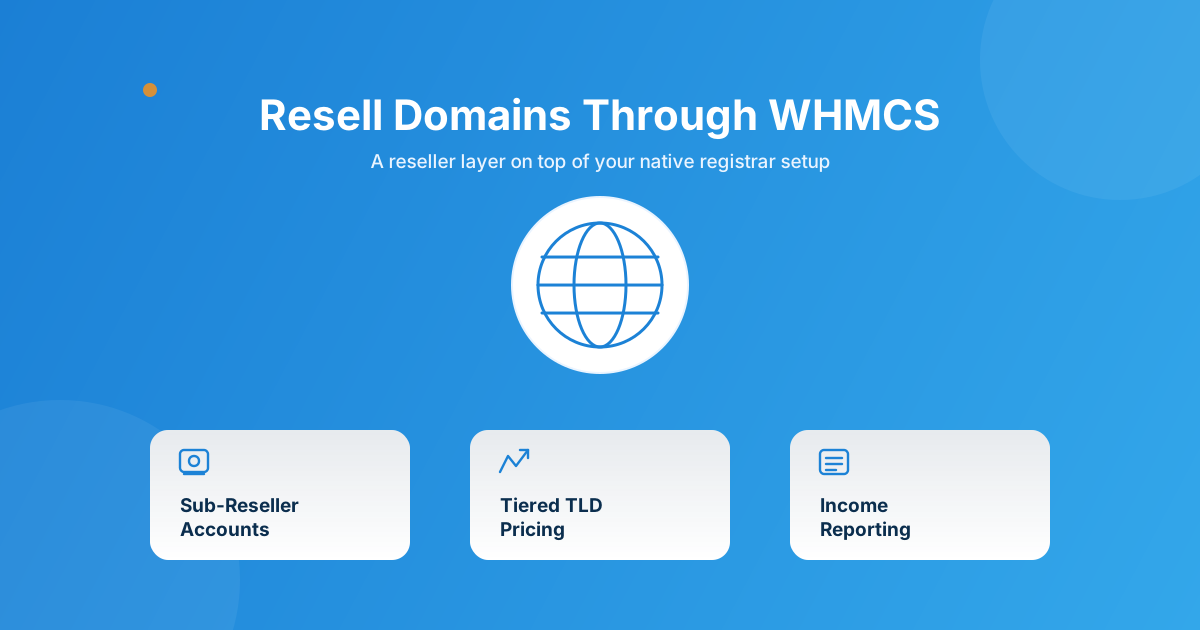
Domain Reseller for WHMCS adds sub-reseller accounts, tiered TLD pricing, and income reporting on top of your existing WHMCS setup. Need something more specific to how your business runs? Our Custom WHMCS Development team builds it around you.
Get the ModuleDomain Reseller for WHMCS
Domain Reselling, Automated
Give partners their own dashboard, API keys, and TLD pricing tiers — plus income reporting so you know who’s actually making you money.
Get the Module View product details →Custom WHMCS Development
Bespoke Modules & Integrations
Need a module, gateway, or integration built around how your business runs? We build upgrade-safe, API-driven WHMCS solutions.
Get a Free Quote View services →