
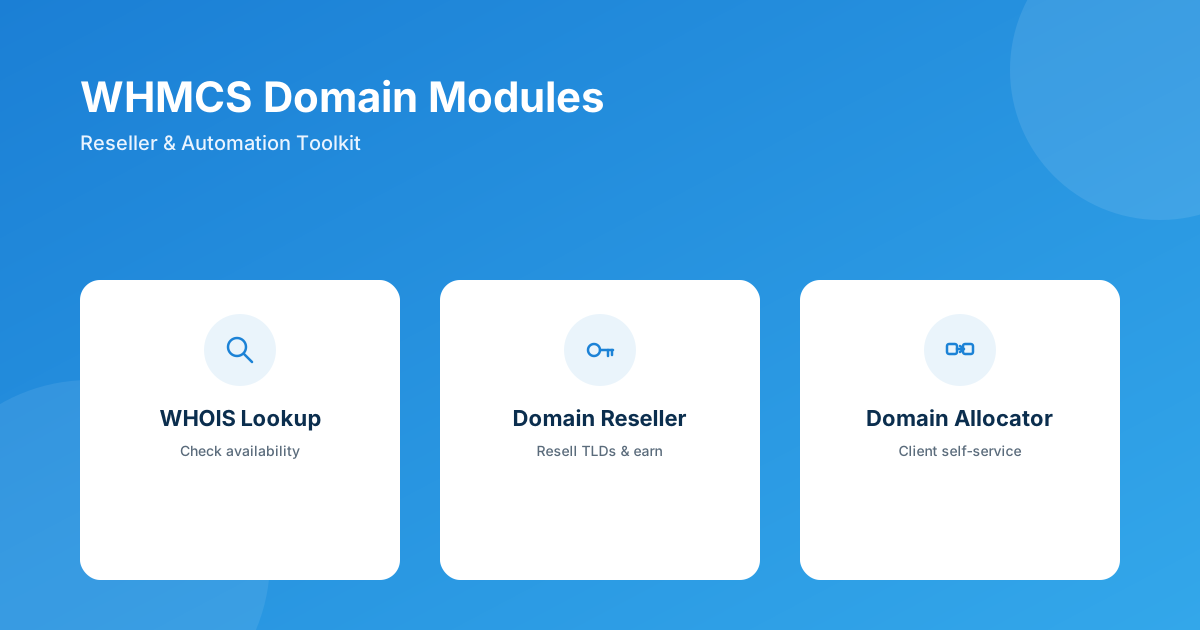
Every WHMCS installation already has domain registration built in — pick a registrar module, connect an API key, and you can sell TLDs. So when hosts ask me about “WHMCS domain modules,” they’re rarely asking about that part. They’re asking about the gap between “domains technically work” and “domains make money and stop generating tickets.”
Most hosts need three layers, not one: WHMCS’s native registrar modules to actually register and renew domains, a dedicated tool to turn that into a real revenue stream, and something that gets clients out of your support queue. For the middle layer, Domain Reseller For WHMCS is the one that does the heaviest lifting.
What people actually mean by “domain modules”
Ask five hosts what a domain module does and you’ll get five different answers, because “domain module” covers at least three separate jobs in a WHMCS stack:
- Registration and lifecycle — actually talking to a registrar’s API to register, renew, and transfer domains. This is the part WHMCS ships with out of the box.
- Reselling and margin — becoming a TLD wholesaler yourself, setting your own pricing tiers, and letting sub-resellers sell under your account.
- Client experience — the storefront and client-area touches that make domains feel less like a form and more like a feature: availability checks, self-service assignment, WHOIS transparency.
None of these three replace each other. A host running a lean reseller operation with 200 clients has completely different priorities than someone reselling TLDs to 40 sub-resellers of their own, and the module list looks different for each.
The layer you already have: WHMCS’s native registrar modules
Before adding anything, it’s worth saying plainly: WHMCS’s own built-in registrar modules are still the most-used way to sell domains, and for good reason. If you’re running eNom, ResellerClub, OpenSRS, Namecheap, or a similar registrar account, WHMCS’s native module connects straight to that API — no add-on required for basic register/renew/transfer/WHOIS-privacy flows. For a lot of hosts, this native layer is genuinely enough, and it’s the foundation everything below builds on top of.
Where it stops being enough is the moment you want your own pricing logic across multiple registrars, want to let other people resell under you, or want clients doing more than checkout — that’s where the modules below come in.
5 domain modules worth adding on top
This list isn’t ranked by “who makes it,” it’s ranked by what actually solves a real problem. WHMCS’s native option leads because it’s the honest default; the rest fill in specific gaps.
| Module | What it does | Best for |
|---|---|---|
| WHMCS native registrar modules | Register, renew, transfer domains via your registrar’s API | Every host — this is the baseline |
| Domain WHOIS Lookup | Instant, login-free availability + WHOIS lookups on your storefront | Reducing checkout friction, boosting conversions |
| Domain Reseller For WHMCS | Build your own TLD reseller/wholesale layer with custom pricing and sub-resellers | Hosts who want domains as a margin product |
| Domain Allocator for WHMCS | Clients assign, attach, or link domains to their own cPanel/Plesk hosting — no ticket needed | Cutting domain-related support volume |
| MCP Server for WHMCS | Register, renew, transfer, and WHOIS-check domains via natural-language AI commands | Teams automating domain admin work |
1. WHMCS’s built-in registrar modules
Still the right starting point. If domains are a small side line for you, don’t overbuild this — connect your registrar, set your markup in WHMCS’s pricing tables, and move on. The three modules below are for once you outgrow that.
2. Domain WHOIS Lookup
This one earns its place because it’s genuinely simple and it sits exactly where buying decisions happen. It checks domain availability instantly for any TLD directly from your storefront, and for already-registered domains it surfaces the registrar name and URL, full registrar contact details, registration status (active, transfer-locked, etc.), nameservers, creation/update/expiry dates, and complete WHOIS contact information for the registrant, admin, technical, and billing contacts — all without requiring a client login. It’s a small addition, but instant answers on the search page convert better than “please wait” spinners, and it doubles as a transparency tool if clients ask “who actually owns this domain.”
3. Domain Reseller For WHMCS
This is the module that changes what domains are worth to your business. It gives you a custom API for reselling TLDs, lets you generate your own registrar integration modules for downstream resellers, and puts granular TLD pricing in your hands by group, currency, action, and even multi-year terms. You can auto-convert clients into resellers on purchase, give each reseller a dedicated area to see their orders, TLD pricing, credit balance, and API keys, and run bulk actions instead of clicking through domains one at a time. On the admin side you get income statistics per TLD and per reseller, full API request/response logs, IP-restricted API access, low-credit alerts, and custom response templates for registrar messages. If you’ve ever felt like domains were a break-even line item next to hosting, this is the module that turns them into their own product line — see the full feature list on the Domain Reseller For WHMCS page.
4. Domain Allocator for WHMCS
Domain-related tickets are some of the most repetitive support volume a host deals with — “can you point this domain at my account,” “I bought a domain elsewhere, can you add it,” “can you set this up as a parked domain.” Domain Allocator for WHMCS hands that job to the client: they can assign their own domains, attach custom domains, or link external domains straight to an active cPanel hosting account from inside their WHMCS dashboard, with no ticket required. It covers addon domains (extra sites under one hosting account) and parked/alias domains (redirects and pointers), and every change reflects instantly through the cPanel API and Plesk API, so there’s no lag between what the client clicks and what actually happens on the server. Admins keep full activity logs of every assignment and API call, and you can restrict who even sees the feature by hosting plan, product group, or client tier — useful if you only want this available to higher-tier plans.
5. MCP Server for WHMCS (the automation layer)
This one is a different shape of “domain module” — instead of a storefront widget, it’s a self-hosted bridge that lets you (or your support team) run domain operations through plain-language AI commands from tools like Claude Desktop or ChatGPT: list domains, register or transfer one, run a WHOIS check, update nameservers, adjust the registrar lock, or pull an EPP code, all without opening the WHMCS admin UI. It runs with zero external data transmission and covers well over a hundred WHMCS operations beyond just domains — billing, services, and reporting included. If your team is already fielding domain requests over Slack or a help desk, this is worth a look purely for the time it saves. More on the MCP Server for WHMCS page.
Frequently asked questions
Do I need a separate module just to sell domains in WHMCS?
No. WHMCS’s native registrar modules already handle registration, renewal, and transfers once you connect a registrar API. The modules in this guide add reselling, storefront WHOIS lookups, or client self-service on top of that baseline — they don’t replace it.
What’s the actual difference between a registrar module and a reseller module?
A registrar module connects WHMCS to one registrar’s API so you can register and manage domains. A reseller module like Domain Reseller For WHMCS goes further — it lets you set your own pricing structure, convert clients into sub-resellers, and track income across TLDs and resellers as its own business line.
Can clients manage their own domains without filing a ticket?
Yes — that’s specifically what Domain Allocator for WHMCS is built for. Clients can assign, attach, or link domains to their active cPanel or Plesk hosting account directly from their WHMCS dashboard, with changes applied instantly through the server API.
Is a WHOIS lookup tool worth adding if registration already works?
If conversion matters to you, yes. An instant, login-free availability and WHOIS check on your storefront removes a point of friction right where buying decisions happen, and it gives existing clients a fast way to check registrar and contact details without emailing support.
The bottom line
Start with what WHMCS already gives you — a connected registrar module covers most hosts’ needs on day one. Layer in a WHOIS lookup if conversion at checkout matters to you, add Domain Reseller For WHMCS the moment you want domains to be a margin product rather than a convenience, and bring in Domain Allocator once domain-related tickets start eating into support time. None of these are “buy everything” decisions — pick the layer that matches the problem you actually have.
Every hosting business handles domains a little differently. Browse the full WHMCS module marketplace to see what fits, or if none of the off-the-shelf options match your workflow, our team can build it.
Get a Free QuoteMCP Server for WHMCS
AI-Native WHMCS Control
Run domain registrations, renewals, transfers, and WHOIS checks through natural-language AI commands — self-hosted, zero external data transmission.
Explore the MCP Server View product details →Custom WHMCS Development
Bespoke Modules & Integrations
Need a module, gateway, or integration built around how your business runs? We build upgrade-safe, API-driven WHMCS solutions.
Get a Free Quote View services →